
Disembodied: A Conversation With Marie Dopita
By: Genaro Ng
Inspiration comes in many forms; for 27 year old knitwear designer Marie Dopita it comes from her affinity with perceptions of reality. Considering herself to be quite sensitive to both nature and art, Marie is no stranger to looking outward for influence, but more importantly, she believes introspection is the key to fueling her creative process.
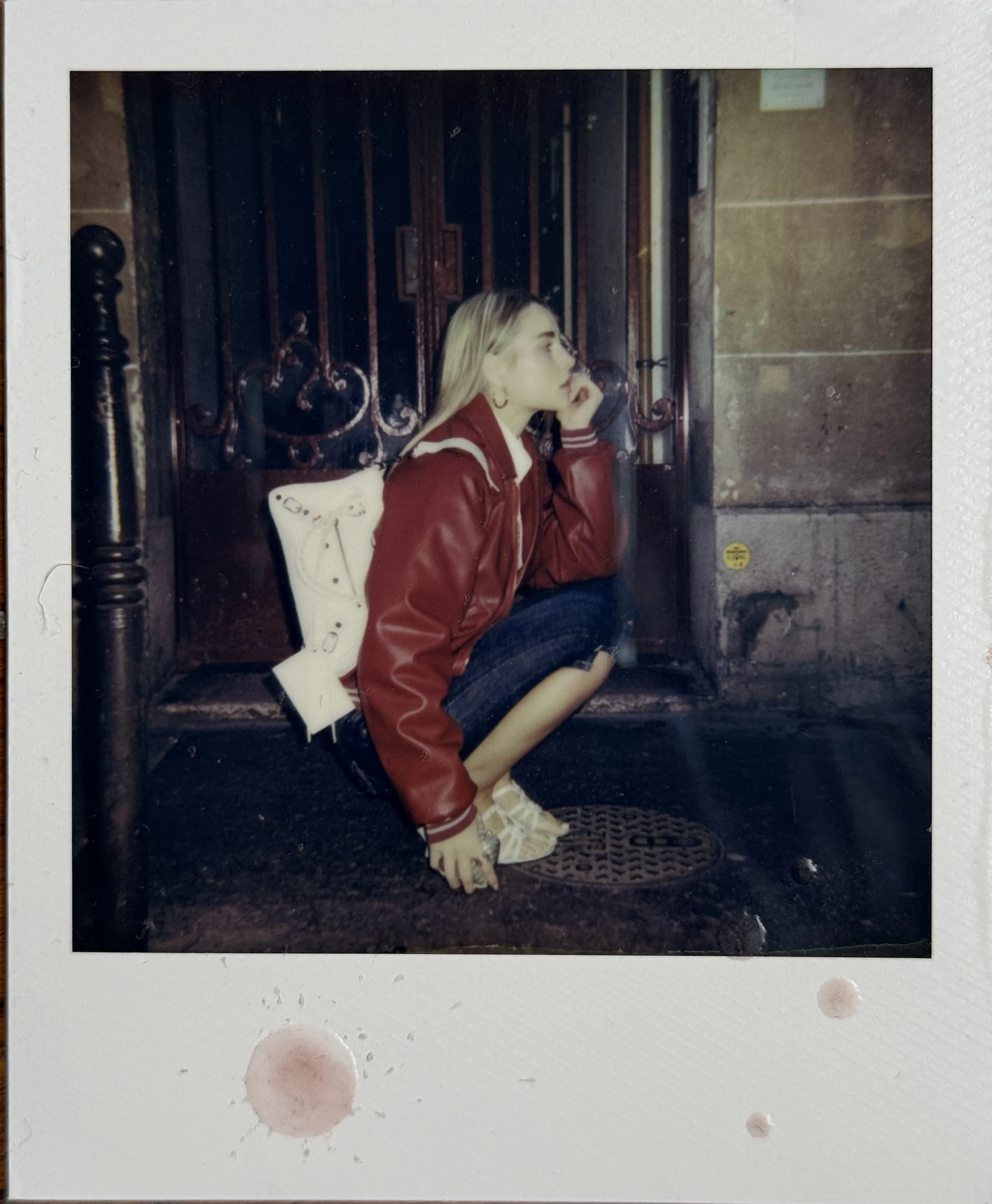
Photo credit: mariedopita
At eighteen years old, Marie moved to Berlin from her hometown in Southern Germany to pursue fashion design at HTW university of applied sciences. Marie recalls college having been a disorienting time to say the least, but she managed to find a way to hone her discombobulation and use it as fuel for her art. Struggling to align with her sense of self, Marie uncovered a curiosity for how we engage with reality, or how we sometimes fail to do so. Derealization thus became a central inspiration to her thesis collection, and the psychological landscape remains largely her inspiration.
Two years ago, Marie made her way to Paris where she’s built a community of creatives both in-person and with her 113K followers on Instagram. Social media has become a tool to showcase her work and spread mental health awareness.
G.N Can you tell me a bit about your family and upbringing?
M.D. My mom is from Germany and my dad is from Czech, so l grew up in both countries, between Prague and a very, very small town in the South of Germany . I actually grew up in a very creative family. My grandpa was an artist and my dad is an artist. When I was young I was taken to a lot of galleries and exhibitions and I always felt connected to art. I started making art myself too when I was a kid.
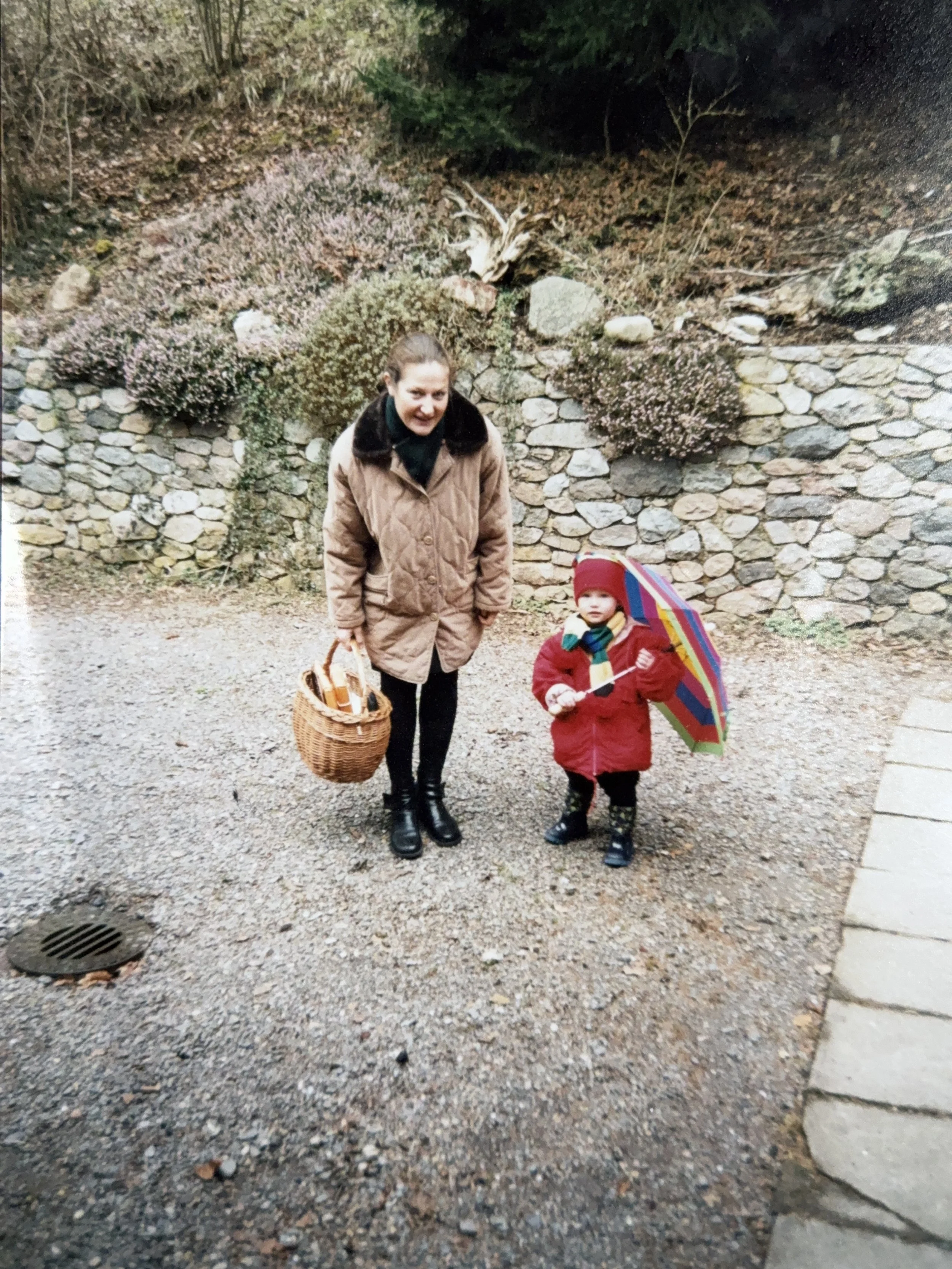
Marie and her mother in Germany, 2000, shot on film.
G.N. When did the idea of designing become concrete for you?
M.D. l started sewing when I was about eight years old. My mom always said that since I could speak I wanted to decide on my own outfits. I would always style myself and I would need hours in the morning, often making me late for school. But I was super stubborn and I wanted to choose my own outfit. When I went to school, I sometimes had crazy outfits on, but I always had this sense of personal style. I just knew what I wanted and even though it was a flop sometimes, I just had a very straight idea in my head. I never really thought about what I wanted to study, I just always knew it was going to be fashion.
G.N. When you began, were you already thinking about knitwear? Did you anticipate that it would become your niche?
M.D. So, I did my whole bachelor in knitting. Everything is knitted. Every accessory, every outfit. It's completely knitted. In university we actually had a knitwear class and I always avoided it. Until I had to decide between knitwear and, I think, 3D printing or something technical which I thought I would hate even more than knitting. So, I just decided to go for the knitwear class, and from the first second I sat down on the machine I absolutely loved it. The inspiration for my bachelor was a mental disorder, which is called derealisation, where people feel disconnected from their mind. I kind of felt very disconnected from myself during that time, so, I loved the idea of representing the feeling of being disconnected in my knitwear. I love that with knitwear you can design everything that you want. You can decide on the colours, you can mix different yarns, you can decide on the pattern, you can decide on the surface - if it's flat or 3D. I always thought of knitwear as super simple, like, that you can only make sweaters. But it's the opposite. Knitwear is super delicate and there are so many facets to it that I just love. There's nothing that you can’t do basically.
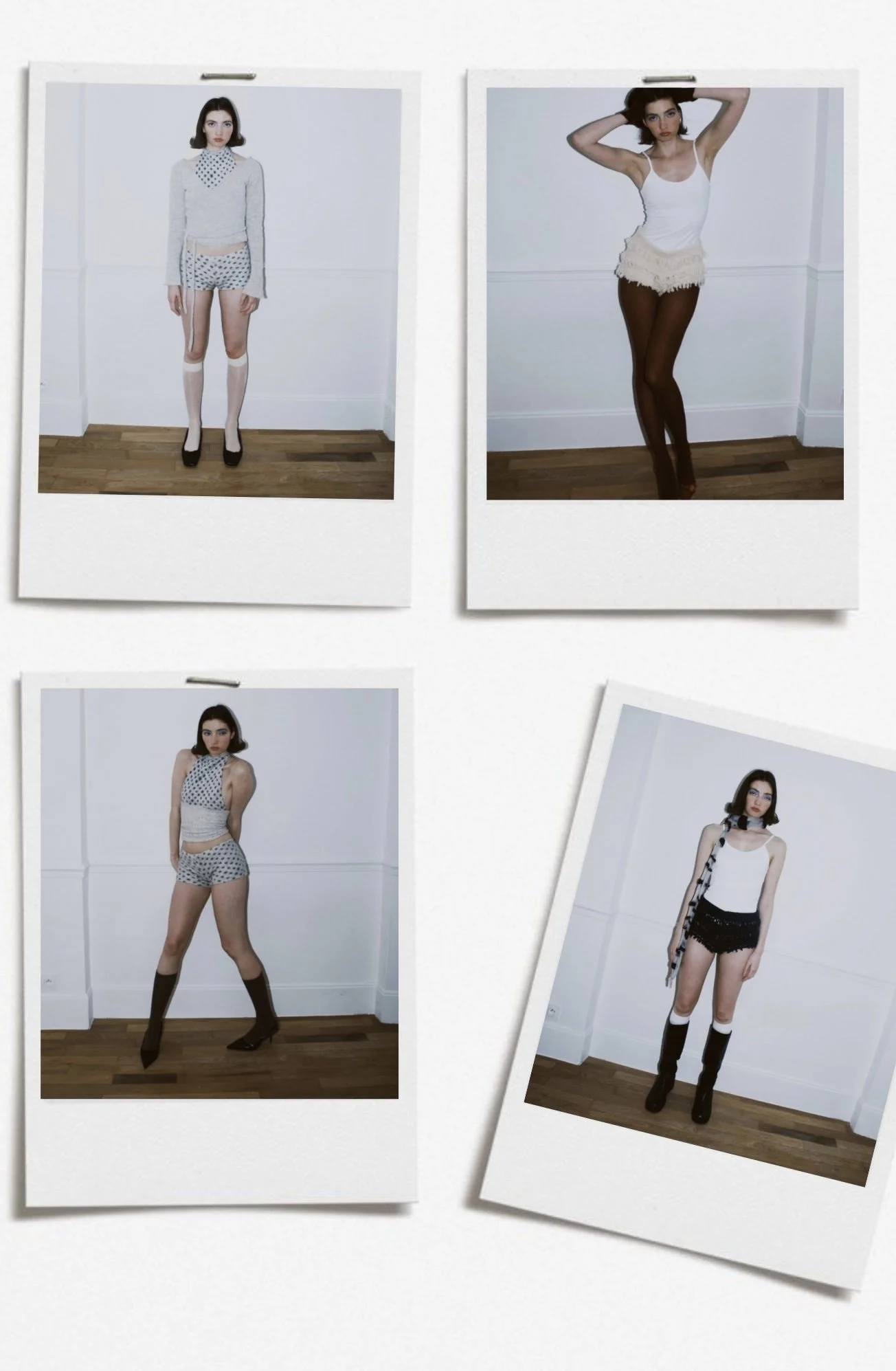
Nila Shevchenko styled by Genaro Ng shot by Kaetano Augusto.
G.N. Many artists, designers, and entrepreneurs move to Paris at a young age, including yourself. Do you find Paris a particularly conductive space for your work?
M.D. Um, yes. I didn't really plan to move to Paris after my bachelor's, I just wanted to do an internship in Paris for two months. I absolutely loved my two months here, so l started searching for an apartment, just for fun, and I immediately found one, so I just decided to be very spontaneous. I just left everything in Berlin and moved to Paris since there is more opportunity for work in knitwear design and also because there's the IFM which has a master degree in knitwear which I'm considering right now if I should do. I love that everything in Paris is just art wherever you go. Even in the smallest café, the menu card is just a piece of art and you get inspired everywhere and from everyone. I also love that you meet creative people at every corner and you get connected super easily, actually. I never had that feeling in Berlin, but in Paris I meet creative people from every type of art, like, not just fashion, but for example also film or art history or so many different things that inspire me a lot. I love to have conversations with people from different fields of art. That's why I love Paris so much. And also because there are a lot of ways to get access to art. There are so many amazing museums and galleries and exhibitions and it's just super inspiring.
G.N. What does community mean to you in the world of design? How has your community supported your journey?
M.D. I love the community of young creative people in Paris. They always like to stick together and support each other. That's at least my experience so far. I met a lot of young people that are stylists, photographers or other kinds of artists and a lot of them wanted to support my vision and help me. So I really love that about Paris, and personally I get a lot of support from my surroundings which I'm really, really thankful for. And also my community on Instagram. I get a lot of positive feedback which motivates me everyday to keep going and to not give up. It's just so nice to see people love your designs.
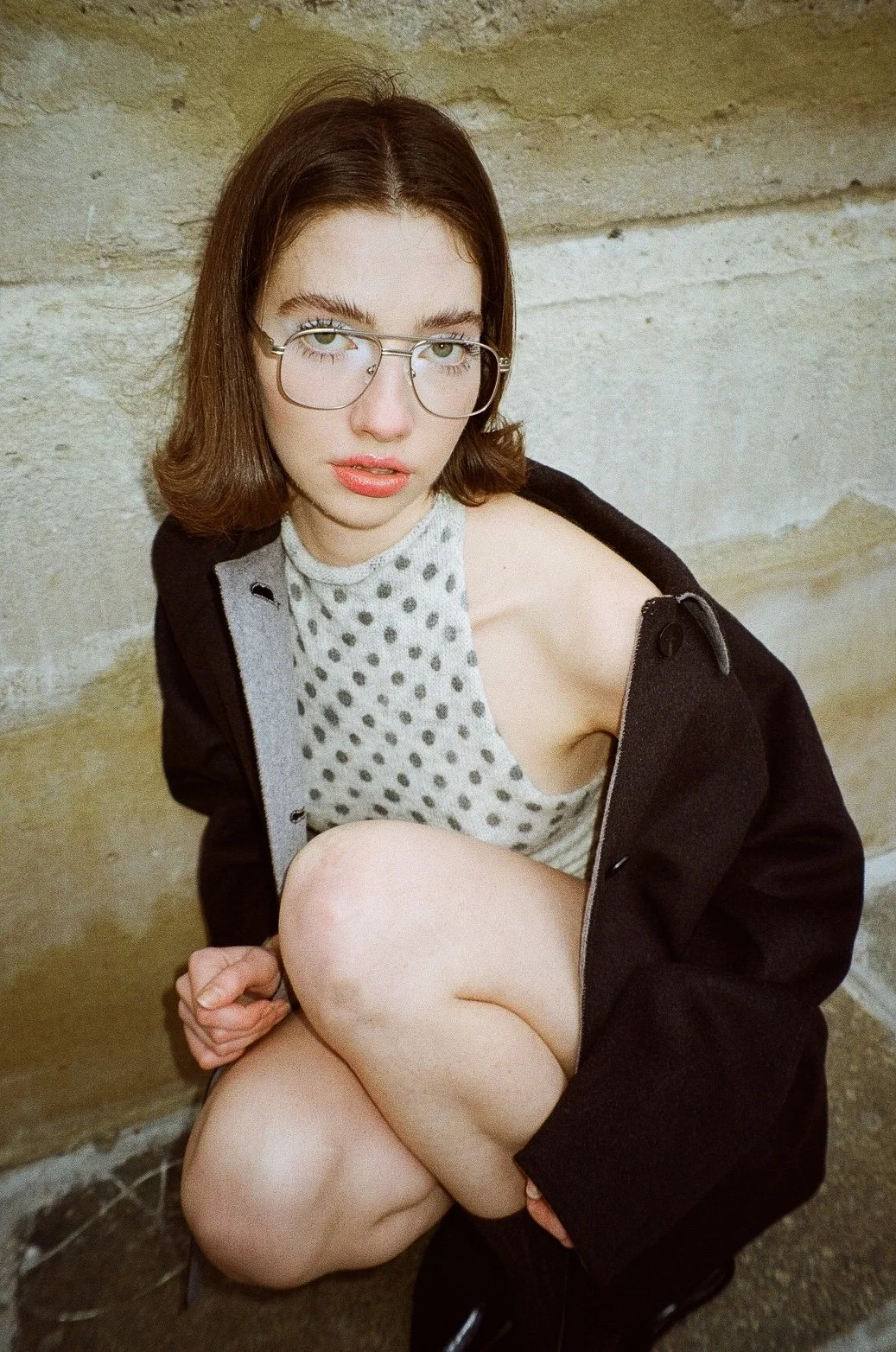
Nila Shevchenko styled by Genaro Ng shot by Kaetano Augusto.
G.N. As a young artist, how do financial pressures interfere with your creative goals, if at all?
M.D. I think it's sad how sometimes money can limit your ideas or visions, but also in my opinion, you can make a lot of amazing things without a big budget, especially when it comes to, for example, making a shooting. You don't need a big budget for that. You just need creative people that make the best out of nothing. And luckily, I know people like that. But of course I feel like as a young designer you never have your safe monthly income. You have to check from month to month how it's going, and then calculate really well what you're going to spend money on. Is it going to be rent for a studio, for example? Or is it going to be an intern? Or is it going to be money for production? So you really have to make smart moves with the money that you have.
G.N. In today’s turbulent global political climate and taking into consideration the plethora of other social pressures you work under, where do you look to for inspiration?
M.D. I get a lot of inspiration when I go to museums or stuff like that, but also a lot in my everyday life. I'm very connected with nature, also, and I got a lot of ideas from that. I'm actually going to do a collection soon that's connected with some type of nature, but I can't say exactly what yet. I also find a lot of inspiration in mental states and sometimes disorders, mental disorders. I feel like I'm bad at speaking about what's going on in my mind. I have always been, and it's just hard for me to express myself. But to express myself with art was never a problem for me. So instead of with words, I express myself with my art, which is my knitwear. Sometimes I also write some poetry or something like that. I prefer to express myself with my creative movements everyday.
G.N. In what ways do you consider your work a manifestation of derealization?
M.D. I would say it's with the yarn I chose and the techniques that I use that represent derealisation. It’s represented in the collection in that derealisation lays over a person's body, like a fog. That's how patients describe it. So I wanted to make delicate layers and use delicate yarns that are almost see through to represent the fog. It's always around, but you can really see it. The yarn is scrunched up which is like the anxiety part. And then also the way the yarn is falling apart is like their mind is falling apart, kind of.
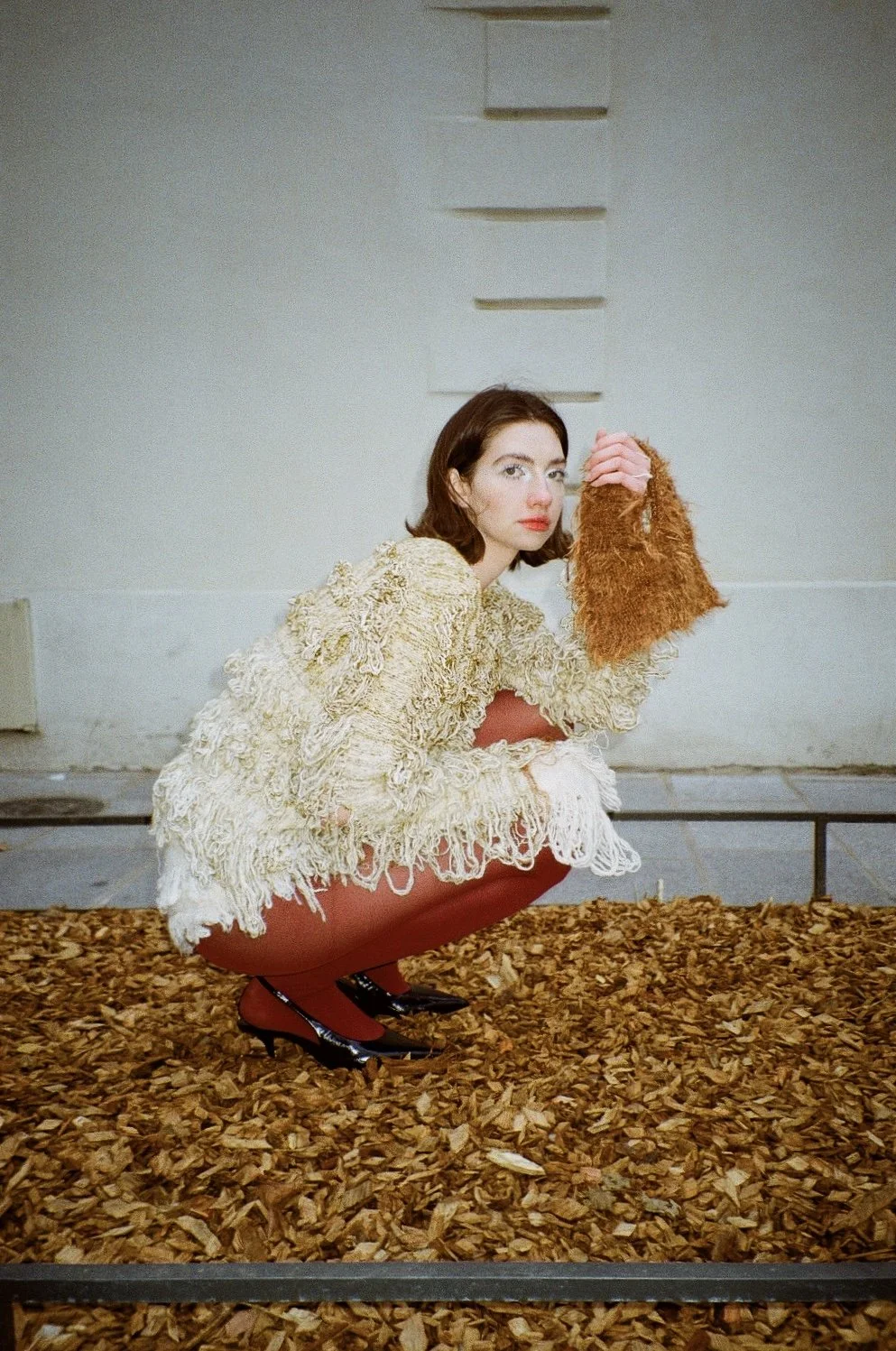
Nila Shevchenko styled by Genaro Ng shot by Kaetano Augusto.
G.N. Where do you see yourself in 10 years?
M.D. In 10 years I just know I’ll have an amazing little print. I will have an amazing team. I want a small team, I don't want it to be too big. But I know my brand will turn into my heart, which it already is, but it will be the main focus of my life. Right now, I have a lot of side jobs, as well. But, it will be my joy and my fulfillment. I can't wait for that part. I just know that it's going to happen. There are some things in life where you’re just sure, where you just have the feeling like you know that's how it's going to be. And I just know that this is how it's going to be.
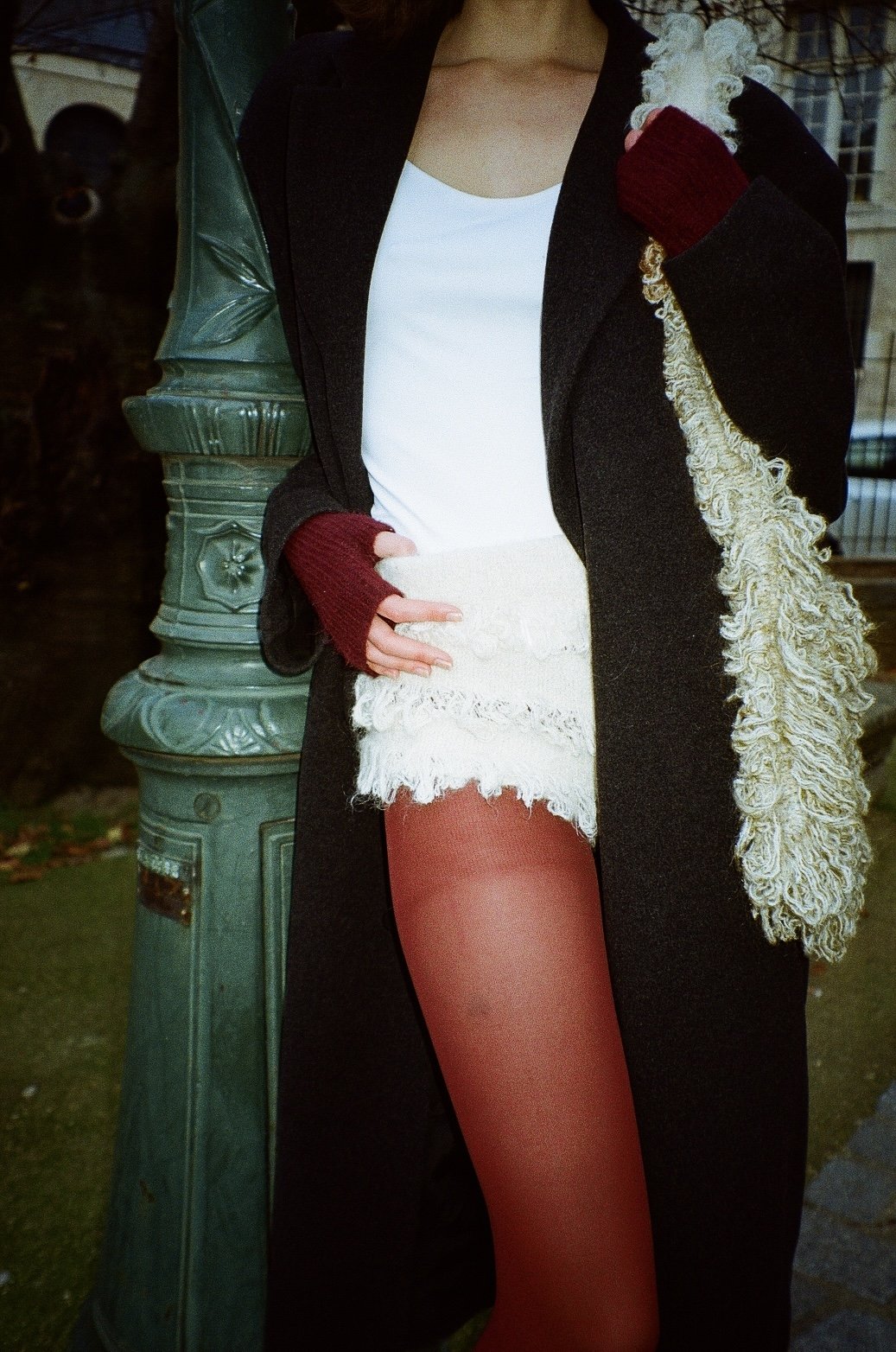
Nila Shevchenko styled by Genaro Ng shot by Kaetano Augusto.